A collection of tools, organisations, and knowledge to support your organising—drawn from HAFCAC’s experience and the wider movement.
Standing on the Shoulders of the Movement
HAFCAC didn’t invent disability rights organising — we learned from those who came before us and worked alongside amazing organisations. This page connects you to the resources, organisations, and knowledge that supported our work and continue supporting activists today.
We’ve organised these resources by what you might need at different stages of organising: understanding your rights, building your campaign, finding legal support, and connecting with the movement.
HAFCAC Historical Documents
Preserved materials from our campaigns—examples of how we framed issues, organised communities, and fought back during austerity.
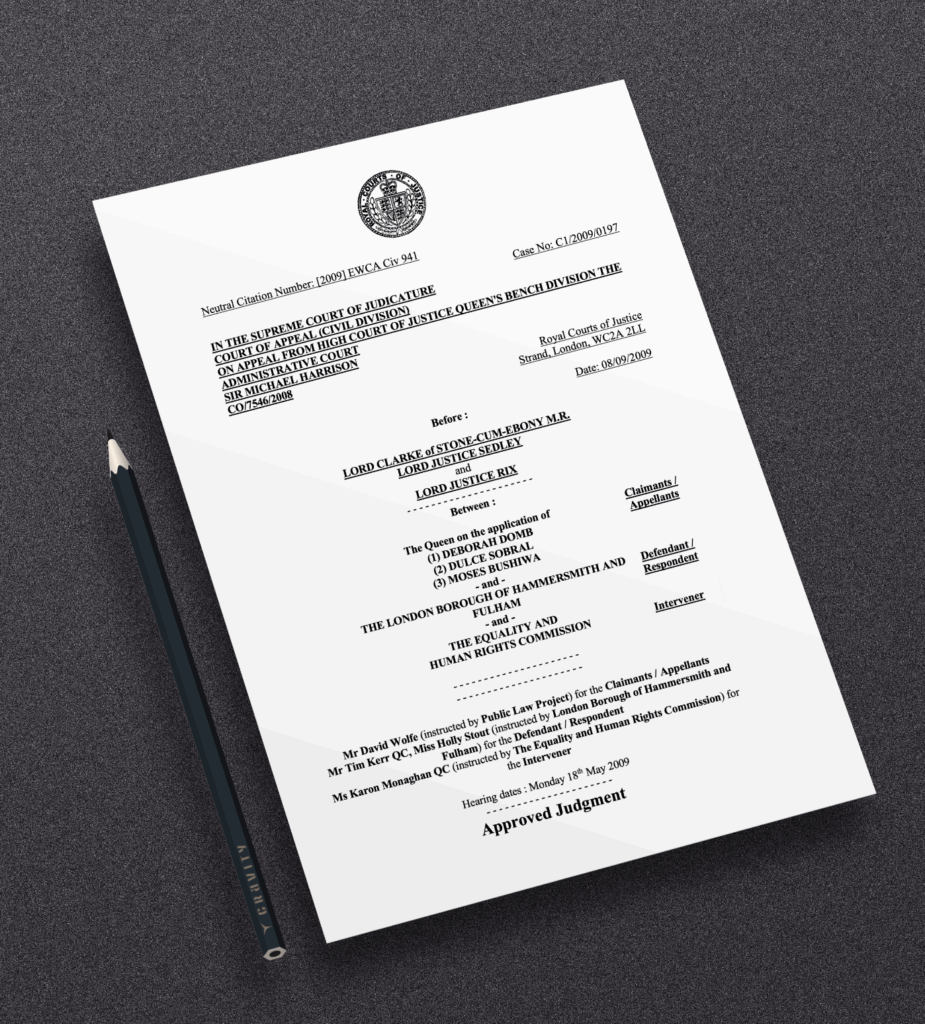
2009 Legal Challenge Judgment
Full text of Domb v Hammersmith & Fulham appeal—the case we “lost” but that proved our determination.
PDF | September 2009
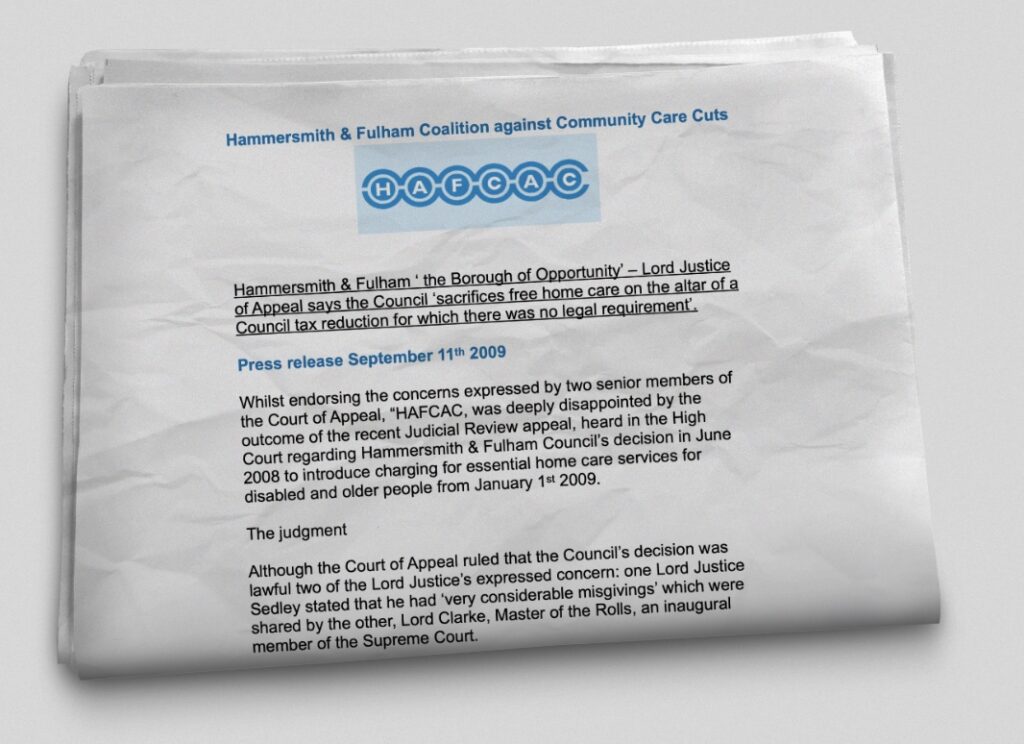
2009 Press release
HAFCAC press release responding to the loss of appeal
PDF | September 2009
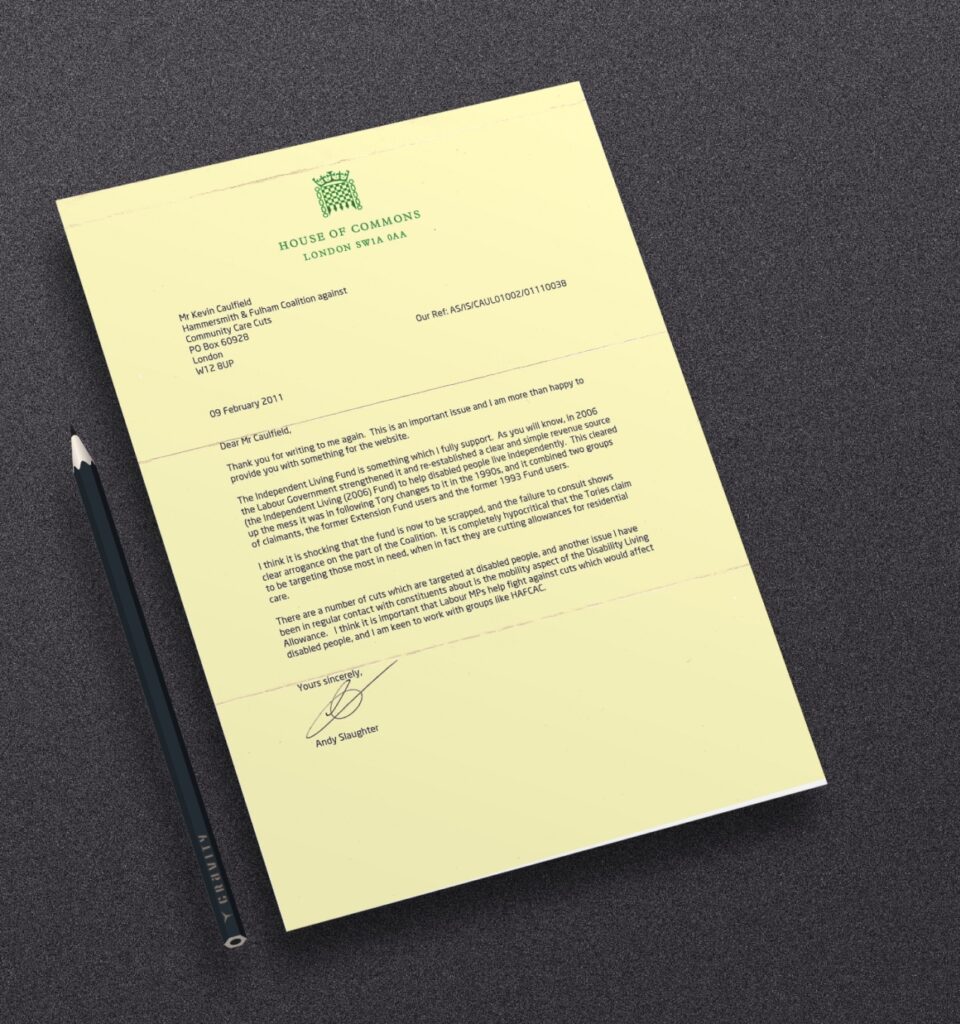
ILF Appeal letters
Our letter to Andy Slaughter MP and a response from him and from Greg Hands MP in regard to our efforts to stop the closure of the Independent Living Fund
3 documents compressed in a .zip file
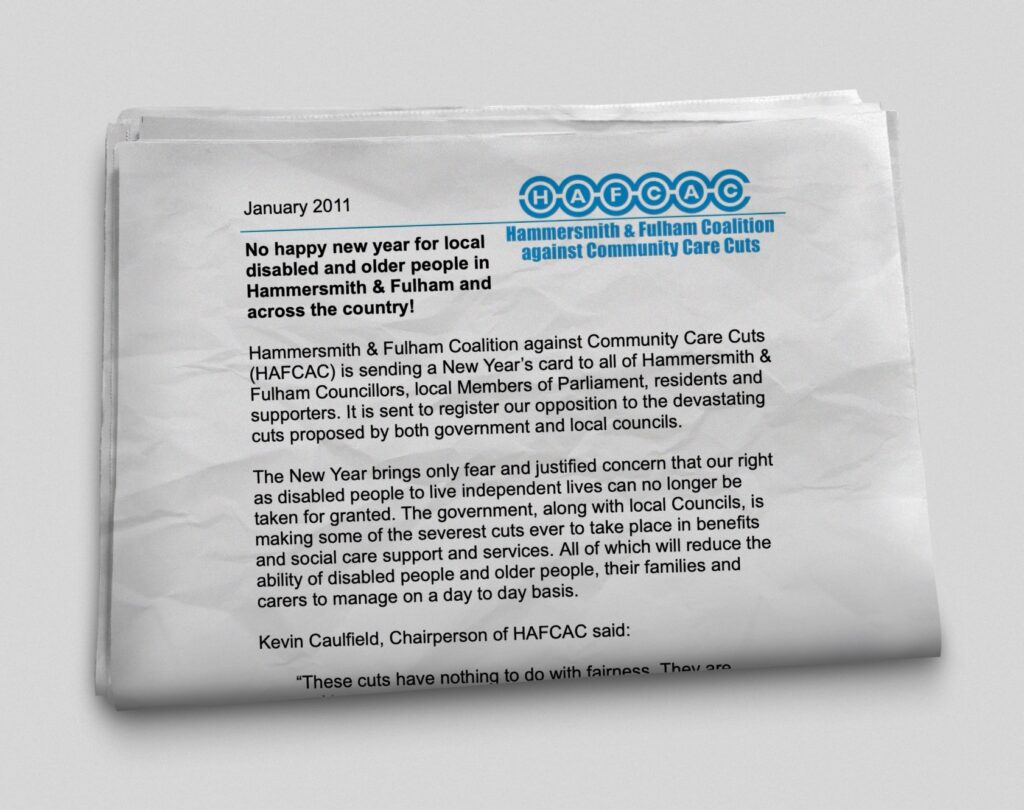
2011 New Year Press Release
“No Happy New Year for local disabled and older people”
– Our response to devastating austerity cuts targeting Disabled people.
Word document | January 2011
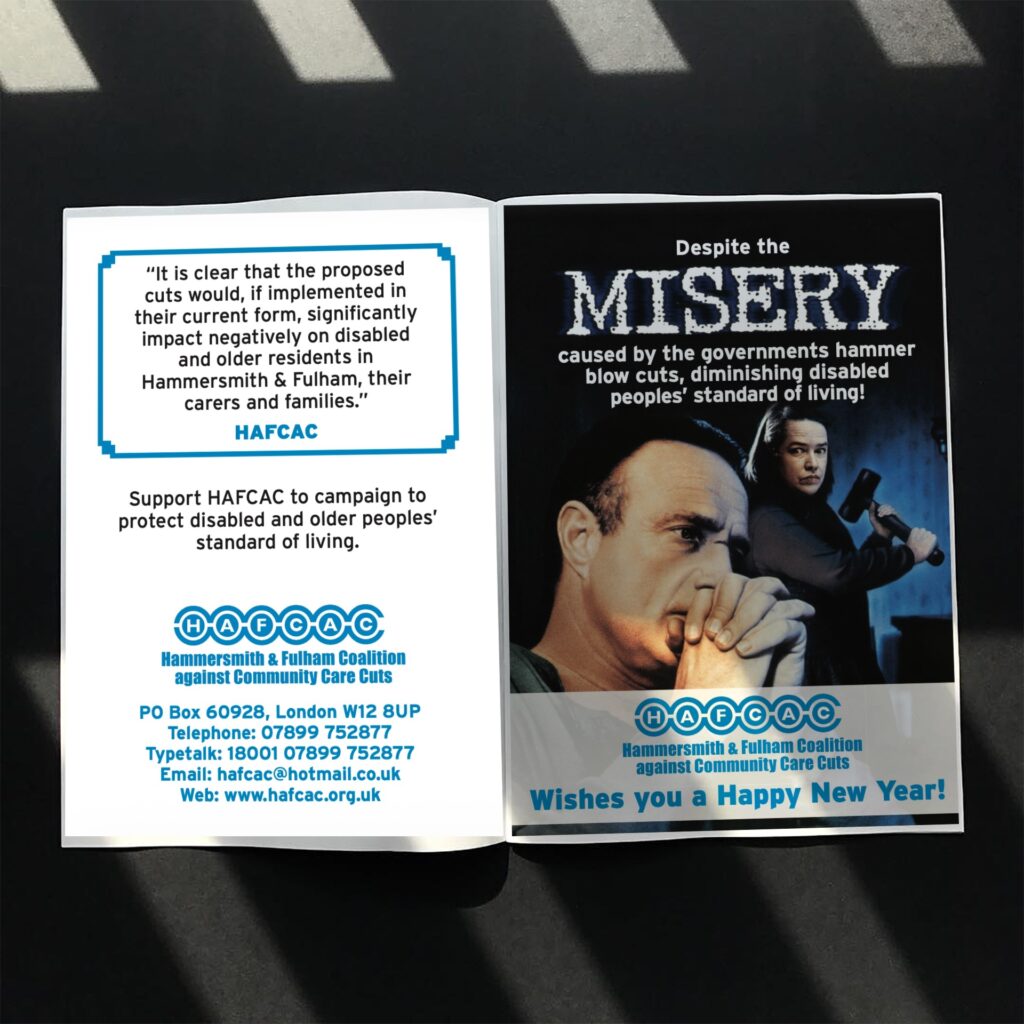
2011 Campaign Leaflet
Campaign leaflet and “Happy New Year” card highlighting cuts to Disabled people’s standard of living.
PDF | January 2011
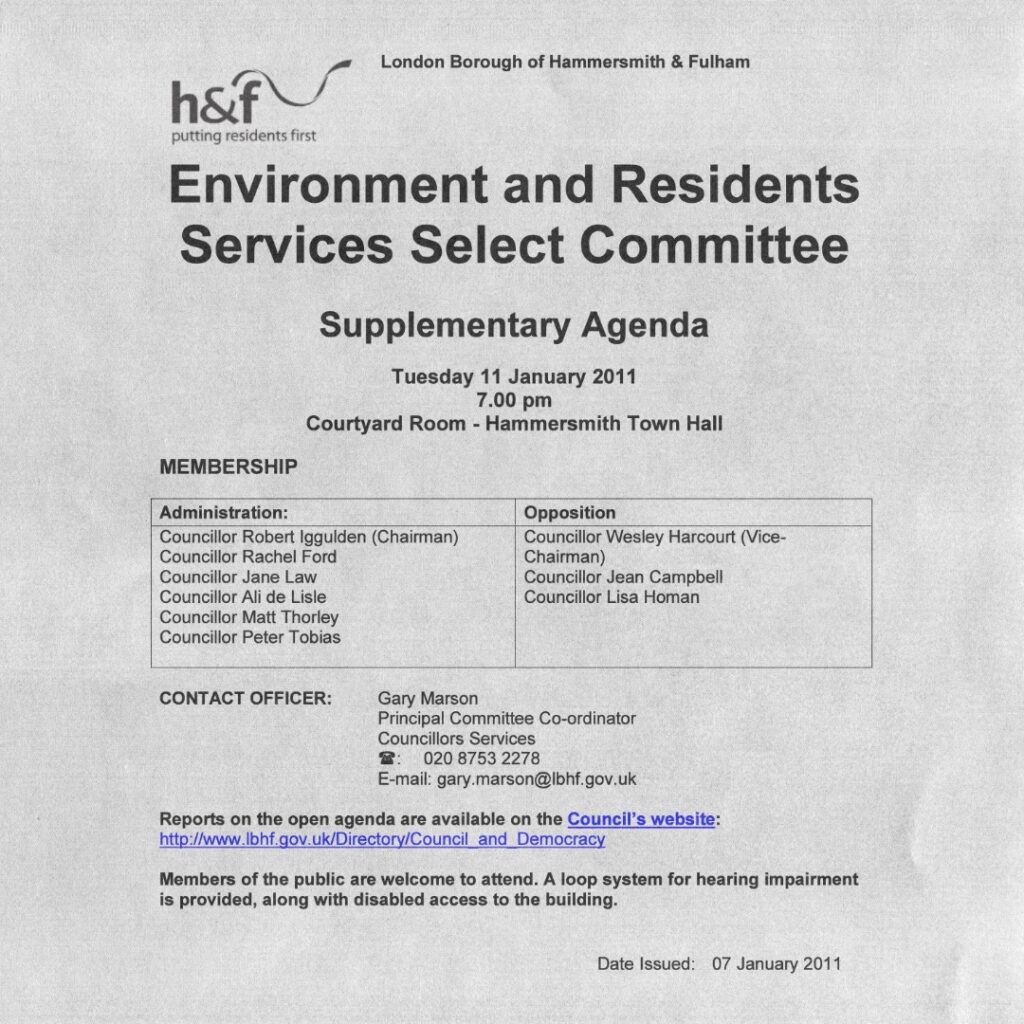
LBHF 2011 Budget Proposal
The council’s proposed cuts that HAFCAC organised against—essential context for understanding our campaign.
These documents show how we framed our campaigns during one of the hardest periods for Disabled people. Use them as examples when creating your own materials.
Understanding Disabled People’s Rights
Before you can fight for your rights, you need to know what they are.
Disabled people have identified 12 basic rights which must be met before we can assume control of our lives and enjoy equality with non-disabled people. These rights guided HAFCAC’s work:
- Full Access to our Environment
- A fully Accessible Transport System
- Technical Aids – Equipment
- Accessible/Adapted Housing
- Personal Assistance
- Inclusive Education and Training
- An Adequate Income
- Equal Opportunities for Employment
- Appropriate and Accessible Information
- Advocacy (towards Self-Advocacy)
- Counselling
- Appropriate and Accessible Health Care Provision
When any of these rights are violated or restricted, that’s where campaigns begin. HAFCAC’s fight against charging was about protecting the right to Personal Assistance—support to live independently.
The Social Model of Disability
Understanding the social model is fundamental to disability rights organising. The problem isn’t our impairments—it’s the barriers society creates.
❌ Medical Model
Disability is an individual problem caused by impairment.
Solution: “fix” or “cure” the individual.
Example: “You can’t access the building because you use a wheelchair.”
✅ Social Model
Disability is caused by societal barriers. Solution: remove barriers and discrimination.
Example: “You can’t access the building because society built it with only stairs.”
Further Reading:
“A Tale of Two Models: Disabled People vs Unum, Atos, Government and Disability Charities” by Debbie Jolly (2012)
This article explains why the UK government’s adoption of the “biopsychosocial model” undermines disability rights. Essential reading for understanding the policy context HAFCAC worked within.
Co-Production:
Working With Decision-Makers
One of HAFCAC’s biggest victories was helping to establish co-production as the default in H&F. Here’s what that means and how to demand it in your area.
What Co-Production Actually Means
“Co-production means local Disabled residents are working together with decision makers to actively identify, design, and evaluate policy decisions and service delivery that affect our lives and remove the barriers we face. Disabled people are equal to the other decision makers involved.”
— Disabled People’s Commission Report
Co-production is NOT consultation where they ask your opinion and ignore it. It’s NOT token representation on advisory boards with no power. It’s shared decision-making from the start, with resources and accountability.
See Co-Production in Action: Hammersmith & Fulham
In 2018, H&F became the first council in the UK to make co-production the default way of working. Their website documents how it works in practice—use this as an example when advocating for co-production in your area.
The council’s co-production page includes:
- Updates from the co-production implementation group
- Information about the Disabled People’s Commission
- How Disabled residents can get involved
- Examples of co-produced services and policies
Organisations That Support Activists
These organisations provided resources, support, and solidarity to HAFCAC—and they can support your organising too.
Inclusion London
Pan-London network of Deaf and Disabled People’s Organisations. Inclusion London provides training, resources, research, and campaigns for disability rights across London.
Key Resources:
- Disability Justice Project – Helps DDPOs use law to challenge discrimination, builds partnerships with legal community
- Research and reports – Including the “One Year On” Independent Living Fund evaluation that informed HAFCAC’s work
- Training and capacity building – For DPOs and activists
- Campaign support – Solidarity and coordination across London
Contact: 020 7237 3181 | info@inclusionlondon.org.uk
Action on Disability
Local Disabled People’s Organisation that worked closely with HAFCAC throughout our campaigns. AOD now runs the Direct Payment Support Service in H&F—one of HAFCAC’s victories.
What AOD Provides:
- Direct Payment Support Service (by Disabled people, for Disabled people)
- Local disability advocacy
- Part of H&F’s DPO network
- Continuing work in co-production
Contact: 020 7385 2098 | info@aod.org.uk
Public Law Project
Supported HAFCAC’s 2009 legal challenge (Domb v Hammersmith & Fulham). PLP works on strategic litigation to hold public bodies accountable and advance social justice.
What PLP Offers:
- Legal advice and representation for public law challenges
- Research and policy work
- Training for advisers and communities
- Strategic litigation to create precedent
If you’re considering legal action as part of your campaign strategy, PLP can advise whether you have a case and how to proceed.
Disability News Service
Independent journalism covering disability rights, campaigning, and injustices facing Disabled people. DNS covered Kevin Caulfield’s 2024 Parliamentary testimony about home care charging.
Why DNS Matters:
- Independent reporting by and for Disabled people
- Covers grassroots campaigns and policy issues
- Holds government and councils accountable
- Essential for understanding current disability rights issues
Stay informed about what’s happening in disability rights across the UK—and get ideas for your own campaigns.
ENIL – European Network for Independent Living
European-wide network of disability rights organisations. HAFCAC’s Kevin Caulfield and Tara Flood presented at ENIL’s Freedom Drive in Brussels in 2019, sharing our campaign strategies with activists across Europe.
International Solidarity:
- Connect with disability rights activists across Europe
- Learn from campaigns in other countries
- Annual Freedom Drive events and protests
- Workshops and knowledge sharing
Disability rights is a global movement. ENIL shows we’re not alone — activists everywhere are fighting for independent living.
Continuing the Work in Hammersmith & Fulham
While HAFCAC closed in 2021, these local organisations continue advocating for Disabled people in the borough.
• Action on Disability: see above
• Safety Net People First: Supporting people with learning difficulties in H&F
Additional Learning & Research
Key documents and resources for understanding disability rights frameworks and policy.
Essential Reading:
- “One Year On: Independent Living Fund Closure Evaluation” (Inclusion London) – Report showing what happened when ILF closed. HAFCAC used this research to demonstrate why ring-fencing mattered.
- UN Convention on the Rights of Persons with Disabilities (CRPD) – International human rights treaty specific to Disabled people. The framework for our rights globally.
- “Nothing About Us Without Us” Survey (H&F, 2017) – The survey that informed the Disabled People’s Commission. Example of good engagement practice (read full report here)
- Disability News Service Archives – Historical coverage of disability rights campaigns and injustices across the UK.
Use These Resources to Win
HAFCAC learned from those who came before us and worked alongside amazing organisations. Now you can learn from us and connect with the movement that’s still fighting.
Know of Other Useful Resources?
If you know of organisations, toolkits, or resources that would help disability rights activists, let us know and we can add them to this page.